
Why Most Teams Are Stuck at Stage 2 of AI Adoption
Tools are in production. The delivery model around them never showed up.
Ninety-seven percent of developers use AI tools today. If you stopped there, you’d think the AI transformation was basically done. It isn’t, and the adoption curve explains why.
There are five stages between a company’s first AI pilot and AI actually running at enterprise scale.
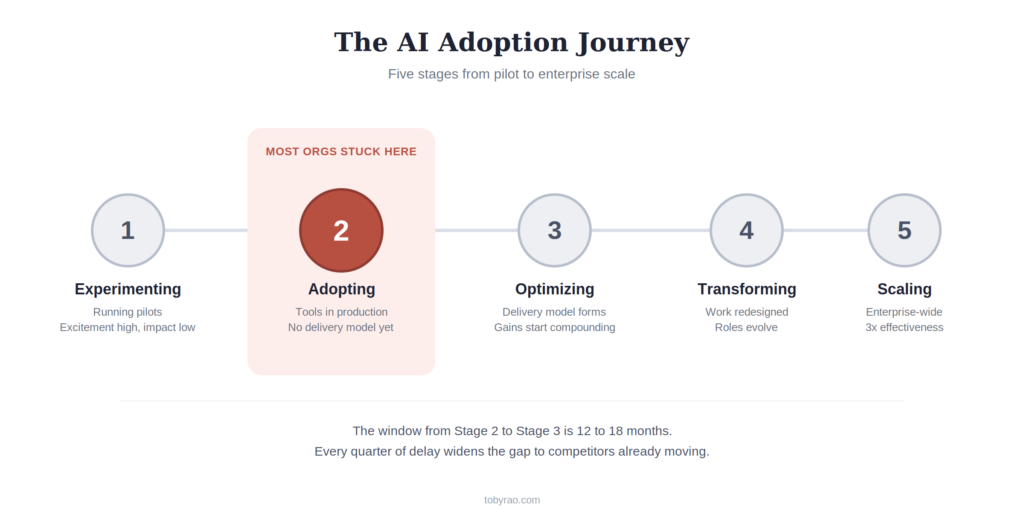
**Stage 1: Experimenting.** Pilots running, use cases getting explored. Excitement is high. Impact is low. AI is still a side project, not part of how work actually gets done.
**Stage 2: Adopting.** Tools move into real workflows. Early wins start showing up. And this is where most organizations live, indefinitely. Tools are in use. No delivery model exists around them.
**Stage 3: Optimizing.** Workflows get refined, outcomes get measured, and this is where the value starts compounding instead of just accumulating. A delivery model starts to form around the tools that were adopted piecemeal in Stage 2.
**Stage 4: Transforming.** Teams fundamentally change how they deliver. Roles evolve. AI is embedded in every stage of the process, not bolted onto the old process as an extra step.
**Stage 5: Scaling.** AI embedded organization-wide. Early movers pull ahead at roughly three times the effectiveness of teams still stuck earlier on the curve. The gap widens every quarter that passes.
Here’s the part that should change how you think about timing. The window to move from Stage 2 to Stage 3 is twelve to eighteen months. Not indefinite. Every quarter of delay in that window widens the gap to competitors who already moved, and that gap compounds the same way the value does once you’re past it.
## Maturity frameworks are broken
Every major consultancy has an AI maturity model. Gartner has a five-stage scale. McKinsey has its own. Now there’s a wave of seven-stage frameworks built around agentic AI. Different labels, same underlying narrative: climb to the top or you’re not mature.
Here’s what running an actual AI transformation at a mid-market organization taught me. Reaching the highest stage isn’t feasible, or even necessary, for every company. And when an organization doesn’t get there, it’s rarely a failure of execution. More often it’s a byproduct of real constraints: strict industry regulation, company size and scale, realistic budget, and core business goals that were never going to require Stage 5 in the first place.
To be clear, this is not an argument for staying stuck at Stage 2. Stage 2 means tools in production with no delivery model around them, and that’s a real problem worth fixing regardless of your constraints. But if an organization builds a real delivery model and stabilizes at Optimizing, with mature practices, healthy ROI, and consistent results, that’s a different situation entirely. If operational constraints genuinely block the move to Transforming or Scaling from there, does that organization deserve to be labeled less mature? I don’t think so.
The hardest lesson I’ve learned running this kind of transformation: maximizing results within your actual operational limits is the peak maturity level for that organization. Chasing the next stage on someone else’s framework was never the goal. ROI and value realization are the goal. Sometimes those point to the same place. Often they don’t.
Why do so many teams get stuck at Stage 2 specifically? Because Stage 2 feels like success. Adoption numbers look great. Developers are using the tools. Leadership sees the dashboard and checks the box. But adoption of a tool is not the same thing as a delivery model built around that tool, and the two get confused constantly because they both produce a green metric.
The tell that you’re stuck at Stage 2 rather than progressing toward Stage 3: you can point to tool usage, but you can’t point to a change in your delivery process that happened because of it. Sprints run the same length. Estimates get built the same way. Metrics still track velocity instead of flow. The tools changed. Nothing around the tools did.
Moving to Stage 3 doesn’t require more tools. It requires deciding what changes about how the team works now that the tools exist, and then actually changing it. That’s a harder conversation than buying another license, which is exactly why most organizations avoid it and call adoption good enough.
Where is your team on this curve, honestly? Not where the tool-usage dashboard says. Where your actual delivery process says.