
AI Transformation: The Pragmatic Three-Layer Approach
Aim wide. Narrow the target. Only the center counts.
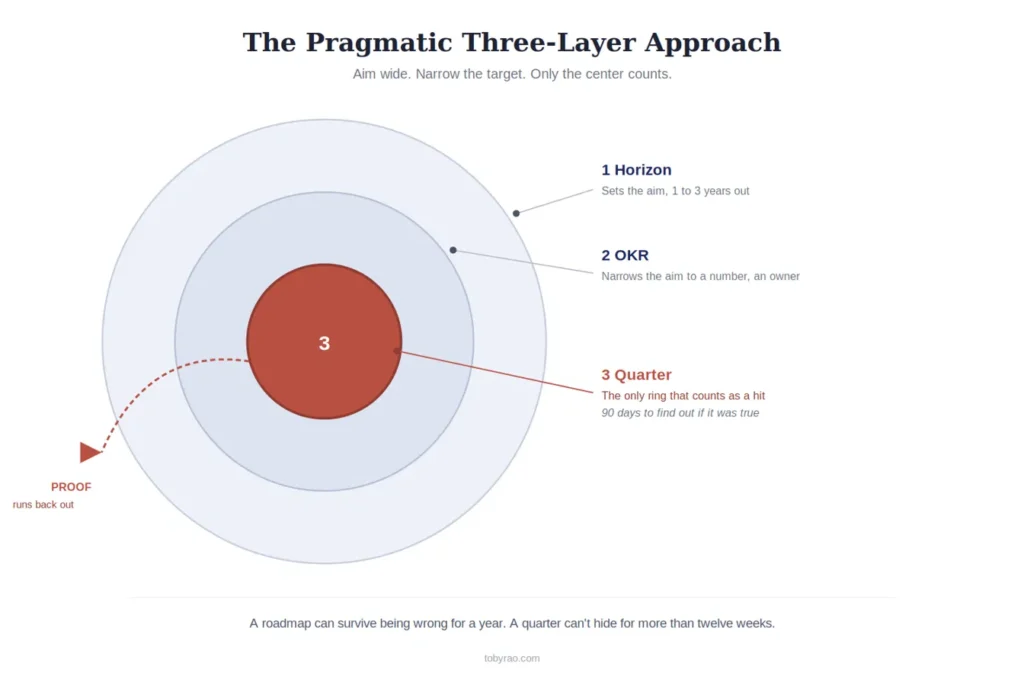
AI transformation doesn’t happen in a deck. It happens inside the quarter.
Most organizations start with a roadmap: clean swimlanes, confident arrows, a horizon eighteen months out. It looks mature. It feels like leadership. And it captures exactly one third of what transformation actually requires.
Direction, translation, proof. Three separate layers, not one deck trying to do all three jobs at once. Picture them as rings on a target, not links in a chain. Get all three right, and the roadmap becomes what it should have been from the start: the opening move, not the whole plan. Here’s how the three layers work.
Layer 1: The horizon sets direction
Start with the term you already know. The roadmap. That artifact still has a job, it was just never scoped correctly. Call the correctly-scoped version the horizon: where the organization is trying to be one to three years out, independent of any single quarter’s noise. This is the only layer where a roadmap-shaped artifact still earns its place. Direction matters, and a team with zero sense of where it’s heading isn’t better off than one with a rigid plan.
The mistake most organizations make is stopping here, at the roadmap, and calling it the transformation. A roadmap describes intent. You can write “AI-enabled delivery model, Q3” on a slide and nobody argues with you, because intent costs nothing to state. The horizon tells you where. It was never built to tell you how, or whether you actually can.
Layer 2: OKRs translate the horizon
An objective takes the horizon and turns it into something worth aiming at this year. The key results are what actually get tested, each one with a number and an owner attached, so “improve delivery” becomes “cut review-stage cycle time by 20 percent this quarter,” and either it happens or it doesn’t.
This is also where most OKR programs quietly fail. They set a good objective, then measure activity instead of the key result. In the AI transformation I led, the OKRs that mattered were the ones tied to delivery outcomes, not to tool adoption. Adoption numbers look great on a slide. They don’t tell you whether delivery actually changed. The horizon is the compass. The OKR is the bearing. Neither one moves the ship.
Layer 3: The quarter tests it
The quarterly plan is where the OKR either survives contact with reality or doesn’t. Roadmaps run on assumptions: this team will have capacity, that integration will be straightforward, adoption will follow training. Quarterly plans run on evidence, because a quarter is short enough that you find out fast whether the assumption held.
Try to actually ship an OKR in a 90-day window with a named owner and a measurable target, and the plan starts talking back. Which teams are actually ready. Which integrations are harder than anyone scoped. Which capability gaps were invisible until someone tried to close them on a deadline. The deck never argues back. The quarter always does.
I’ve watched this play out directly running an AI transformation across more than a dozen engineering teams. The eighteen-month roadmap slide impressed people in the room. It taught us nothing. The quarterly plans are where we found out that code generation adoption was uneven across teams for reasons the roadmap never surfaced, that review capacity was the real constraint once generation got fast, and that some of our estimates for “AI-enabled” were closer to marketing language than engineering reality. None of that showed up until we tried to deliver against a short, specific window and measured what happened.
The target, not the chain
Picture the three layers as a target instead of a chain. Horizon is the outer ring, the widest aim. OKR is the middle ring, narrowing that aim into something specific enough to shoot at this year. Quarter is the center, the only ring that actually counts as a hit.
A horizon without OKRs is an outer ring with nothing narrowing toward it, a wish with no aim behind it. OKRs without quarterly evidence are a middle ring that never gets fired, a slogan dressed up as a target. A roadmap can survive being wrong for a long time, because nobody checks it closely until the deadline arrives. A quarter can’t hide for more than twelve weeks.
Here’s what most target diagrams miss. Proof doesn’t just travel inward. It runs back out. Every quarter you actually hit tells you something about whether the OKR was aimed correctly. Every OKR that keeps missing tells you the horizon itself needs to move. The outer ring gives the center something to aim at. The center is what tells you whether the outer ring was ever real to begin with.
If you want to know whether your AI transformation is hitting the target or just describing one, don’t look at the roadmap. Look at your last three quarterly plans. What did you say you’d do. What actually happened. What changed because of what you learned. If those three columns look identical quarter after quarter, the outer ring is the only thing moving, and nothing is actually flying toward it.
Want momentum? Run the test.